Exercise #58
In Their Shoes: Understanding Refugees’ Health in a Humanitarian Crisis
Authors: Assoc. Prof. Paloma Moral de Calatrava
80–90 minutes
Description
Students explore the health challenges faced by refugees in humanitarian crises through a structured four-phase exercise: reading a case scenario, group discussion across four health domains, role-play of a clinical consultation, and individual written reflection.
Methodological Guide
Objectives
Develop empathy and critical thinking about refugee health in humanitarian crises. Identify immediate physical and mental health problems faced by displaced populations. Apply trauma-informed, culturally sensitive approaches to clinical communication. Recognise ethical challenges and the professional role of health workers in crisis settings. Strengthen reflective practice by connecting emotional experience to professional skill development.
Expected Outcomes
Students demonstrate empathy and critical analysis of refugee health scenarios; apply trauma-informed and culturally sensitive communication in role-play; articulate ethical considerations; and produce a thoughtful individual reflection.
Exercise Procedure
Part 1 — Case Scenario (10 min): Students read the case of Samira individually.
Part 2 — Group Discussion (30 min): Small groups discuss four topic clusters — Physical Health, Mental Health & Psychosocial Support, Public Health, and Ethics & Professional Role.
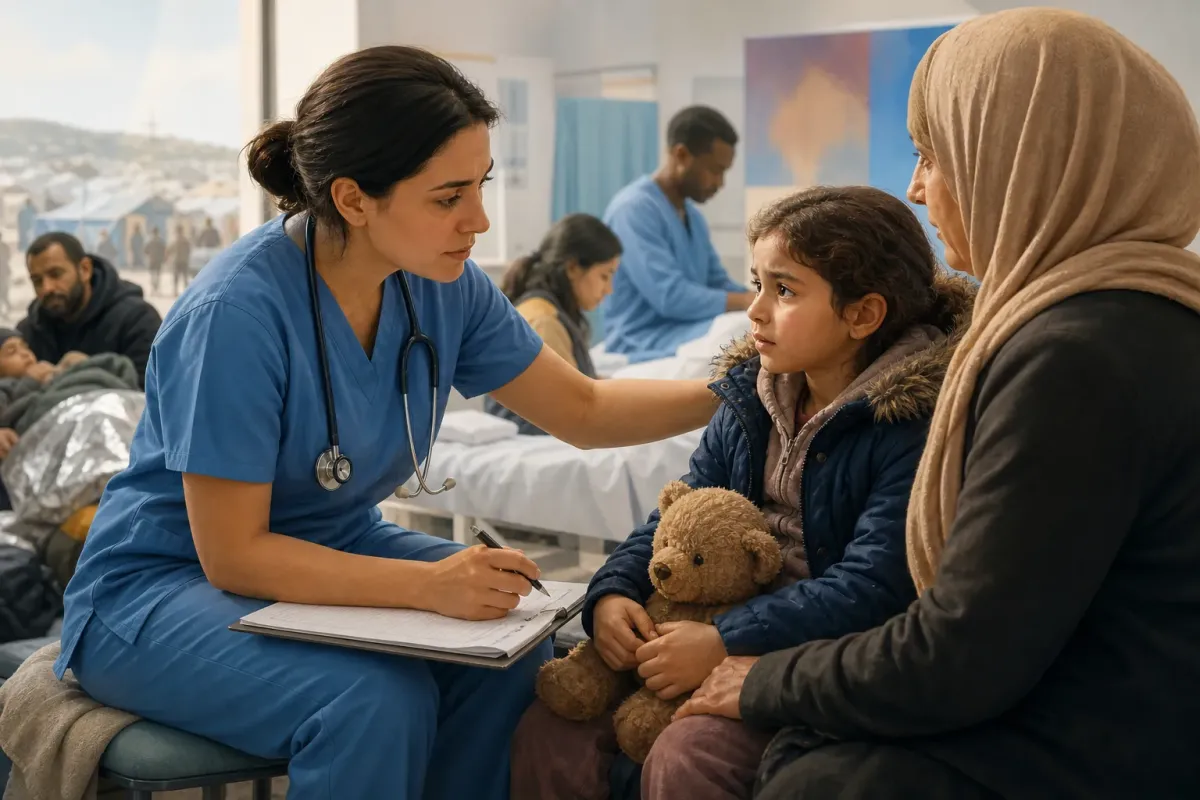
Part 3 — Role-Play (30 min): One student plays Samira, one plays the nurse/doctor, one plays the translator. Goal: practice trauma-informed care, active listening, and culturally sensitive communication.
Part 4 — Reflection (10 min in class or homework): Each student writes a short reflection on emotions experienced and one skill to strengthen.
Part 2 — Group Discussion (30 min): Small groups discuss four topic clusters — Physical Health, Mental Health & Psychosocial Support, Public Health, and Ethics & Professional Role.
Part 3 — Role-Play (30 min): One student plays Samira, one plays the nurse/doctor, one plays the translator. Goal: practice trauma-informed care, active listening, and culturally sensitive communication.
Part 4 — Reflection (10 min in class or homework): Each student writes a short reflection on emotions experienced and one skill to strengthen.
Mode of Implementation
Group and individual work in four sequential phases. Phases 1 and 4 are individual; Phases 2 and 3 are small-group activities.
Role of the Teacher
Introduces the exercise and the case scenario. Monitors small-group discussions. Facilitates the role-play debrief. Creates a safe, non-judgmental space for reflection.
Theoretical Basis
The exercise is grounded in case-based, experiential, and reflective learning as applied to humanitarian health education. Case-based learning invites students to analyse an authentic-style refugee camp scenario, moving from facts to clinical reasoning. Experiential learning (Kolb) structures the four phases as a cycle: concrete case, reflective group discussion, abstract conceptualisation of priorities, and active experimentation through role-play. Trauma-informed and culturally sensitive care frames psychological distress, dignity, and cultural background as integral to every clinical decision. Reflective practice (Schön) turns the final written reflection into professional self-awareness about skills still to be developed.
Practical Application
Students gain direct experience formulating care priorities for a complex patient in a resource-constrained setting, practising active listening, trauma-informed communication, and ethically guided decision-making — all transferable to multicultural clinical practice.
Knowledge Transfer
After completing this exercise, students can articulate the physical, psychosocial, and public health needs of refugee populations; apply cultural sensitivity in simulated consultations; and reflect critically on their own emotional responses and professional development areas.
Reinforcement & Reflection
The final reflection prompt asks students to identify emotions experienced during the case discussion and one specific skill or awareness they wish to strengthen when working with refugees or immigrant patients.
Required Resources
Electronic devices with access to the MultiCultiMed platform. Internet connection.
Assessment / Evaluation
Quality of group discussion contributions; realism and empathy in role-play; depth of individual written reflection.
Practical Tips
Encourage students to stay in role during the role-play and to be specific rather than generic in their reflection. Remind the group that there are no ‘correct’ answers — the aim is thoughtful engagement.
Discussion Topics
Social determinants of health in displacement. Trauma-informed care principles. Cultural and language barriers in clinical settings. Medical ethics in humanitarian emergencies.
Further Resources
UNHCR. (2019). The global compact on refugees. United Nations High Commissioner for Refugees. WHO. (2018). Refugee and migrant health. World Health Organization. Bhugra, D., & Becker, M. A. (2005). Migration, cultural bereavement and cultural identity. World Psychiatry, 4(1), 18–24.
Additional Remarks
The case of Samira is intentionally brief to leave space for student imagination and empathy. Facilitators should be prepared for strong emotional responses, particularly from students with personal migration experience.