Exercise #18
Design Your Own Age-Friendly Ward
Authors: Elena Rousou, Paraskevi Charitou, Panagiota Ellina
60–90 minutes
Description
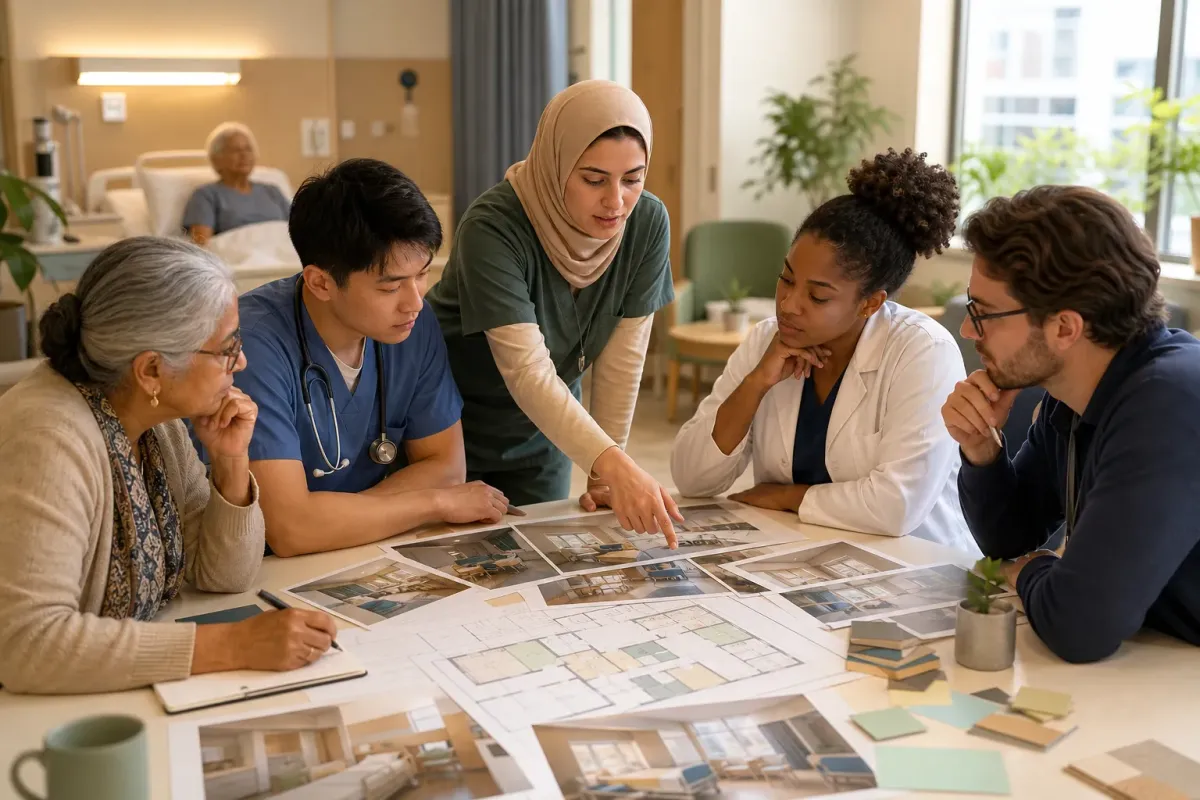
Students review photographs of hospital wards and analyze which environmental features support or hinder age-friendly, safe, and dignified care for older adults from varied cultural backgrounds and with differing physical or cognitive needs. Working in groups, students discuss, redesign, and reflect on how to create more inclusive ward environments.
Methodological Guide
Objectives
Identify environmental features in hospital wards that support or hinder age-friendly, safe, and dignified care.
Analyze the impact of physical design on older patients from diverse cultural backgrounds and with varying physical or cognitive needs.
Apply principles of age-friendly environments to propose practical, low-cost improvements.
Reflect on how cultural background influences older patients’ experience of the ward environment.
Develop advocacy skills for system-level change in healthcare settings.
Analyze the impact of physical design on older patients from diverse cultural backgrounds and with varying physical or cognitive needs.
Apply principles of age-friendly environments to propose practical, low-cost improvements.
Reflect on how cultural background influences older patients’ experience of the ward environment.
Develop advocacy skills for system-level change in healthcare settings.
Expected Outcomes
After completing this exercise, students will be able to:
Identify age-friendly and age-unfriendly features in hospital ward environments.
Propose low-cost, practical improvements that promote dignity, equity, and safety.
Explain how cultural background shapes older patients’ experiences in healthcare environments.
Demonstrate awareness of ageism and its impact on care quality.
Reflect on their own role as advocates for age-friendly, culturally sensitive healthcare.
Identify age-friendly and age-unfriendly features in hospital ward environments.
Propose low-cost, practical improvements that promote dignity, equity, and safety.
Explain how cultural background shapes older patients’ experiences in healthcare environments.
Demonstrate awareness of ageism and its impact on care quality.
Reflect on their own role as advocates for age-friendly, culturally sensitive healthcare.
Mode of Implementation
Group-based activity with individual reflection. Can be delivered in classroom (flip chart) or online (breakout rooms, shared slides, forum).
Role of the Teacher
Introduce the concepts of age-friendly environments and ageism in healthcare. Facilitate group analysis and discussion of ward photographs. Support the redesign task and encourage creative, low-cost solutions. Guide reflection and summarise key takeaways connecting design to dignity, equity, and cultural sensitivity.
Theoretical Basis
This exercise is grounded in the principles of age-friendly health systems (Institute for Healthcare Improvement) and the WHO’s age-friendly environments framework. It draws on research into ageism in healthcare, which highlights how stereotypes and systemic barriers — including inadequate facilities and insufficient geriatric training — affect the quality of care older adults receive. The activity also incorporates intercultural perspectives, recognising that age-friendliness must encompass cultural sensitivity for older immigrants and diverse communities.
Practical Application
Students examine real ward photographs to identify practical barriers and enablers for older patients, then collaboratively redesign the space. This mirrors the real-world task of healthcare professionals who must notice environmental barriers, challenge ageist attitudes, and advocate for practical improvements in their workplaces.
Knowledge Transfer
Students transfer theoretical knowledge of age-friendly principles, ageism, and cultural sensitivity into visual analysis and collaborative redesign tasks. They connect their observations to clinical practice by identifying two things they can apply in their work immediately.
Reinforcement & Reflection
What 2 things did I learn today that I can apply in practice? How might cultural background influence how older patients experience the ward environment? How do design choices promote or undermine dignity, equity, and safety?
Required Resources
Hospital ward photographs (provided in slides). Flip chart or shared slides platform (e.g., PowerPoint, Google Slides). Online forum or breakout rooms for virtual delivery. Optional: arrows, text boxes, stickers for annotating redesign slides.
Assessment / Evaluation
Group presentation: Each group presents their ward analysis and redesign proposals.
Before/after redesign slide: Groups create a ‘before/after’ redesign in shared slides.
Forum post: Individual reflection on ‘What 2 things did I learn today that I can apply in practice?’
Peer feedback: Students give feedback on each other’s redesigns in the forum.
Before/after redesign slide: Groups create a ‘before/after’ redesign in shared slides.
Forum post: Individual reflection on ‘What 2 things did I learn today that I can apply in practice?’
Peer feedback: Students give feedback on each other’s redesigns in the forum.
Practical Tips
Ensure photographs are large enough to be analyzed; include zoom/enlarge functionality. Encourage groups to focus on low-cost, practical solutions rather than expensive renovations. Prompt discussion of both physical and cultural/attitudinal dimensions of age-friendliness.
Discussion Topics
What is age-friendly? What could create difficulties for older patients (including immigrants or culturally diverse groups)? Which design flaws were most critical to address and why? What improvements did your group propose, and how are they low-cost and practical? How do your changes promote dignity, equity, and safety for older adults? How might cultural background influence how older patients experience the ward environment?
Further Resources
Towards an ‘age-friendly-hospital’: Older persons’ perceptions of an age-friendly hospital environment in Nigeria. https://doi.org/10.1080/2331205X.2020.1853895
Age Friendly Health Systems — https://www.ihi.org/partner/initiatives/age-friendly-health-systems
Age Friendly Health Systems — https://www.ihi.org/partner/initiatives/age-friendly-health-systems
Additional Remarks
This exercise complements theoretical modules on aging, ageism, and cultural competence by grounding these concepts in physical healthcare environments. The forum reflection and peer feedback components extend learning beyond the session itself.