Home
Exercise Catalogue
Meeting with Socrates – Working on Prejudices in the Context of Cultural Diversity
Exercise #24
Meeting with Socrates – Working on Prejudices in the Context of Cultural Diversity
Authors: PhD Magdalena Kuczyńska
approximately 90 minutes
Description
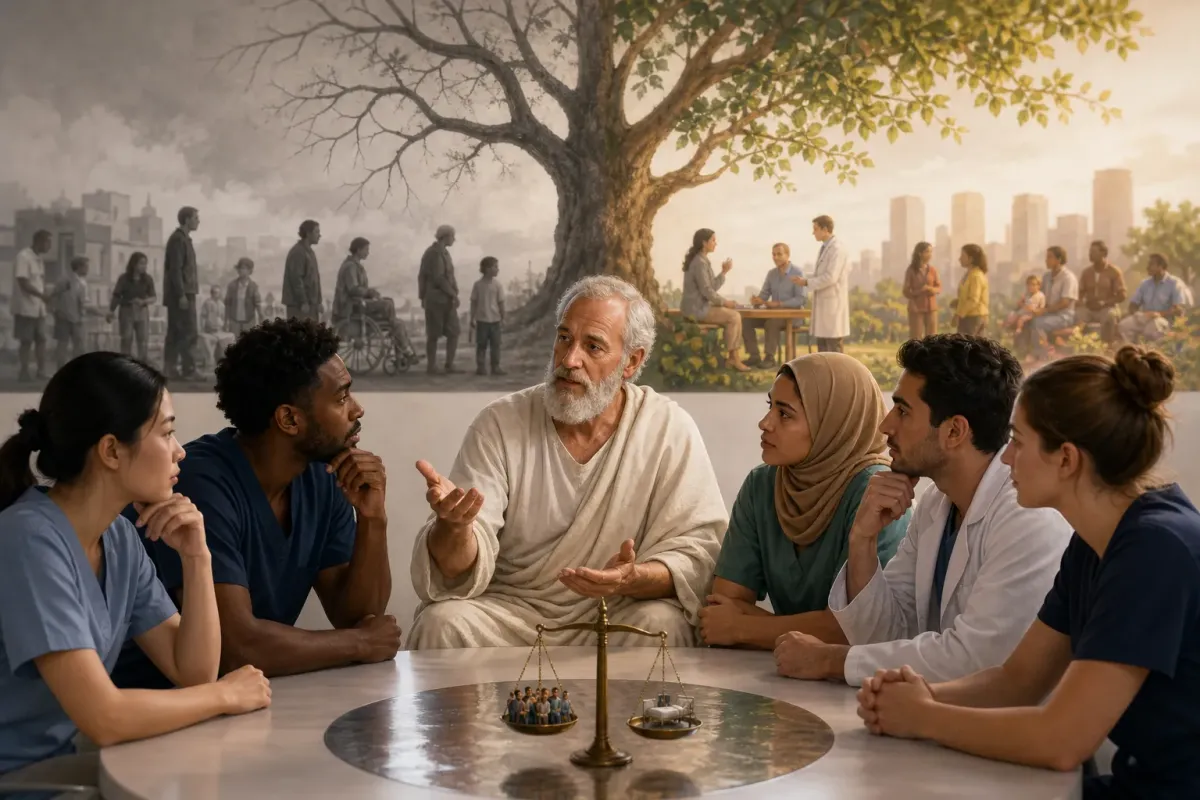
A reflective self-analysis exercise in which students individually map their own cultural biases and prejudices across three categories, then collaboratively interrogate one selected bias using the Socratic dialogue method and the Tree of Thoughts framework, transforming negative perceptions into culturally open perspectives.
Methodological Guide
Objectives
Recognize your own biases toward cultural differences. Encourage reflection on your moral stance toward cultural differences. Stimulate constructive self-criticism of your own cultural biases. Foster a mindset of respect and openness toward cultural plurality.
Expected Outcomes
Identify personal biases related to cultural diversity and recognize the emotions associated with them. Anticipate the negative social consequences of engaging in relationships based on cultural prejudice. Distinguish between behaviors rooted in cultural diversity and those that violate legal and social norms. Develop the ability to transform the 'Cultural Bias Framework' into a 'Cultural Openness Framework'. Build relationships with patients and colleagues based on cultural competence.
Exercise Procedure
Pre-class preparation: ask each student to reflect on 'My attitude toward cultural diversity – prejudices and concerns' and read an excerpt from Plato's Apology of Socrates. Introduction (10 min): introduce the boundaries of cultural tolerance. Level 1a (~10 min): students complete the three-part 'Cultural Bias Framework' individually. Level 1 expansion (5 min): deepen one bias using Socratic guiding questions. Level 2a – introduction to subgroups (5 min): share frameworks, select 3–4 biases, form subgroups of 4–5. Level 2b – subgroup work (25 min): each group analyses an assigned bias and creates a 'Tree of Thoughts'. Discussion (~20 min): groups present their Trees; moderated full-group discussion. Summary (10 min): recap key concepts — Socratic dialogue, boundaries of cultural tolerance, 'Cultural Openness Framework'. Final reflection (5 min): what was the most important learning? Would you reconsider any initial bias?
Mode of Implementation
Level 1 – Individual Work: creative analysis of one's own beliefs and biases in the context of cultural diversity, followed by completion of the 'Cultural Bias Framework'. Level 2 – Small Group Work: collaborative work in small groups focused on a selected area of negative beliefs (prejudices). Discussion – Group presentation of the results of the work in subgroups and a joint, moderated discussion.
Role of the Teacher
Socratic Guide — by applying the Socratic elenctic method (posing a series of questions about the interlocutor's statements), the instructor encourages students to engage in self-reflection regarding their own worldview. Midwife of Thought — the teacher does not reject the prejudices expressed by students. Instead, through thoughtful questioning, they lead students toward an internal confrontation with their own assertions, prompting verification and the 'birth' of new beliefs oriented toward cultural openness.
Theoretical Basis
The exercise is based on the principles of transformative learning: Disorienting Dilemma — students engage in mutual reflection on their personal biases toward chosen cultural and visual differences and critically compare these perceptions with culturally grounded behavioral norms. Critical Reflection — students engage in thoughtful exploration of the underlying factors that may have contributed to the development of their cultural prejudices. Dialogue and Action — using prejudice maps as a starting point, students initiate a dialogue on the impact of negative cultural assumptions in intercultural interactions. Additionally, one may refer to the 'Cultural Bias Framework' created by students from other countries within the MultiCultiMed Platform and compare existing beliefs depending on their place of residence.
Practical Application
The exercise constitutes a vital component in the development of intercultural competence by fostering students' self-reflection on their moral attitudes toward cultural diversity. It enables participants to identify individual sources of prejudice and confront them with current scientific evidence. A key element involves distinguishing behaviors, rituals, and visual expressions rooted in cultural traditions from practices that violate the legal and customary norms of a given country.
Knowledge Transfer
The student strengthens critical self-reflection regarding their own cultural biases. On this basis, they gain the opportunity to transform negative perceptions of cultural differences, fostering open and respectful relationships with patients and colleagues within the healthcare sector.
Reinforcement & Reflection
Self-analysis of the underlying sources shaping negative attitudes toward cultural differences. Student's individual work on their personal 'Cultural Bias Framework' within their profile on the MultiCultiMed Platform, followed by its gradual transformation into a 'Cultural Openness Framework'.
Required Resources
Level 1 – Electronic devices (tablets, mobile phones, or laptops) with internet access. Level 2 – A projector allowing the instructor to present the exercise completed by students in Level 1. Alternative: paper sheets, a whiteboard, and markers.
Assessment / Evaluation
Ask students for a brief reflection on the following question: Would you now reconsider any of the beliefs you initially included in your 'Cultural Bias Framework'?
Practical Tips
Ensure the anonymity of the 'Cultural Bias Framework' — the exercise is about self-reflection. Create a safe and respectful environment. Do not judge students' views or impose your own opinions — allow them to confront their biases independently. If your group includes students from diverse cultural backgrounds (geography, religion, or sexuality), pay special attention to maintaining calm and respectful dialogue.
Discussion Topics
In your opinion, do social media influence our moral attitudes toward cultural differences? What moral competencies can support your independence in shaping attitudes toward cultural diversity? What methods can be proposed to foster an environment of relationships with patients and colleagues that is free from cultural bias?
Further Resources
Lee S., Kim B.: Exploring How Stereotype Modification Mediates the Relationship between Social Dominance and Multicultural Acceptance. Behav Sci (Basel). 2024 Aug 26;14(9):745. doi: 10.3390/bs14090745 — Chaika O., Sharmanova N.: Multiculturalism in modern mass media: analysis of stereotypes. Amazonia Investiga, 11(60), 10–22. https://doi.org/10.34069/AI/2022.60.12.1 — Marpelina L.: Exploring Multiculturalism and Intolerance: Understanding the Dynamics of Diversity. Jurnal Pendidikan Multikultural Indonesia 6(2):66–75. DOI:10.23887/jpmu.v6i2.64695
Additional Remarks
If your group includes students from diverse cultural backgrounds — particularly in terms of geography, religion, or sexuality — pay special attention to maintaining calm and respectful dialogue during discussions. The goal of the class is to bring students together, not to divide them.