Exercise #40
World Map – Cultural Perspectives in Perceiving the World
Authors: Dr hab. Małgorzata Szkup
30–60 minutes
Description
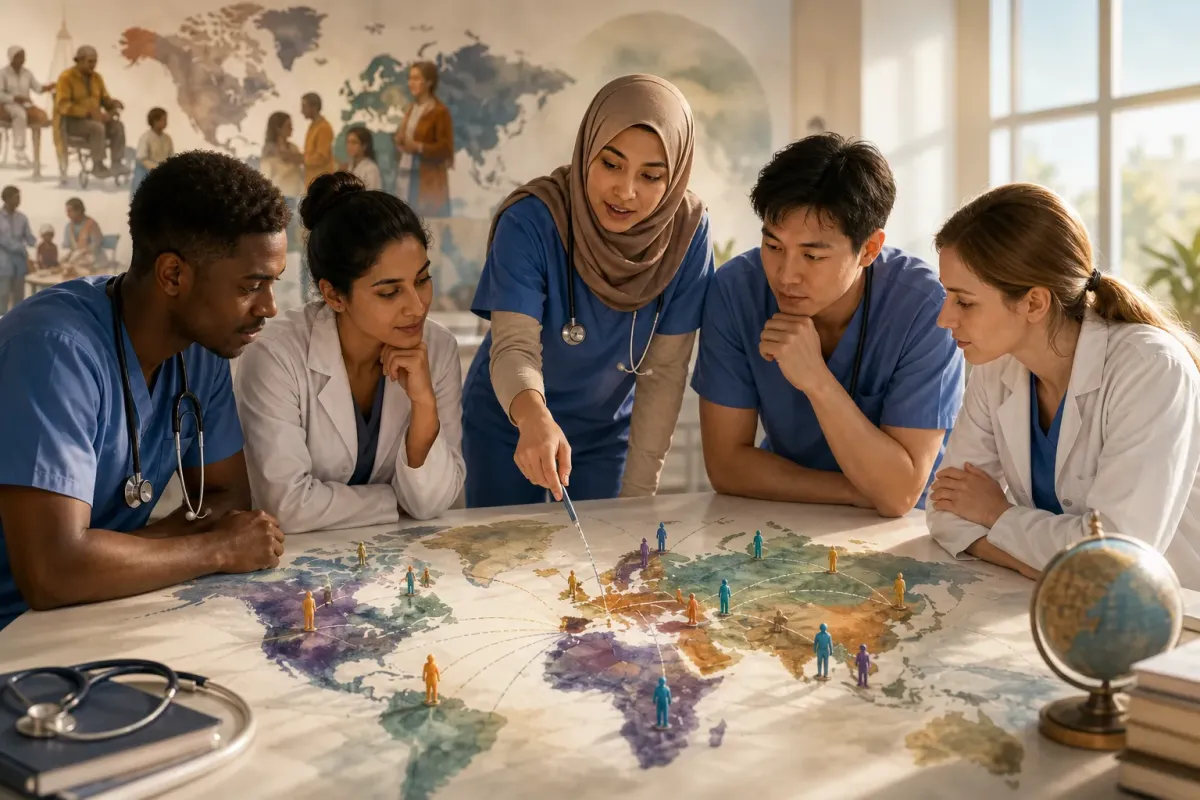
Students draw a world map from memory, then compare their drawings with alternative maps from different cultures, exploring how cultural background shapes our perception of the world and implications for medical practice.
Methodological Guide
Objectives
Raising students' awareness of how their own cultural background influences their perception of the world. Developing reflection on the role of cultural perspective in interpreting reality. Encouraging critical thinking about global narratives and their local representations. Fostering an attitude of openness and cultural humility.
Expected Outcomes
After completing the exercise, students should be able to: Identify their own cultural assumptions and how these influence their perception of reality. Develop reflection on cultural diversity and the need for openness. Gain a better understanding of how cultural context affects the interpretation of information and communication in professional settings.
Exercise Procedure
Introduction (2–3 min): Explain to students that they will be completing a drawing task, but the aim is not to assess their artistic abilities. Stage 1 – Individual part (20 min on platform + drawing time off-screen): Students draw a world map from memory as detailed as possible, photograph it, upload it, and write a short reflection. Stage 2 – Alternative maps (5–8 min): Students browse five world maps from different cultural perspectives and observe how orientation, centre, and emphasis change depending on where the map was made. Discussion (10–15 min): Teacher leads debrief using the maps and the wall as a starting point. Stage 3 – Anonymous reflection (10 min): Students respond to the prompts that resonate most and post to the shared wall. Summary (15 min): Introduce Eurocentrism, cultural egocentrism, and cartographic bias. Final reflection: 'How do our assumptions and mental images influence our work with patients from different cultural backgrounds?'
Mode of Implementation
Stage 1 – Individual (drawing, upload, and written reflection). Stage 2 – Alternative maps slideshow (five maps from different cultural perspectives). Stage 3 – Anonymous peer wall (short reflections shared with classmates).
Role of the Teacher
Guide and moderator – does not evaluate the drawings or the accuracy of the maps, but stimulates discussion and reflection. Provoker of reflection – asks questions that challenge students' assumptions and biases. Group facilitator – ensures an atmosphere of safety, trust, and mutual respect.
Theoretical Basis
The exercise is based on the principles of transformative learning: Disorienting dilemma: Students confront their own mental images with alternative representations of the world. Critical reflection: They analyze why their drawings differ from others and from real maps created in various parts of the world. Dialogue and action: A shared gallery (physical or online) serves as a starting point for open group discussion. As a complement, authentic maps from different cultures (e.g., China, Australia, the USA) are introduced to deepen reflection on the concepts of Eurocentrism and cartographic ethnocentrism.
Practical Application
The exercise fosters cultural awareness useful in the context of working with patients who hold different worldviews. It helps students understand how everyday assumptions influence communication and collaboration. It can serve as a starting point for analogous situations in clinical practice.
Knowledge Transfer
The student develops the competence to analyze how cultural background shapes perception — a skill that can be applied in professional practice when working with individuals from diverse backgrounds (e.g., different value systems, approaches to health and the body).
Reinforcement & Reflection
Reflection on personal cognitive filters as an element of self-assessment in the development of cultural competence. Self-reflection in a reflective journal, e.g., What interesting insight did I gain today about the way I perceive the world?
Required Resources
Electronic device with internet access for the platform. Sheets of paper and markers/pens for drawing. Camera or smartphone to photograph the drawing.
Assessment / Evaluation
Ask students to record a self-reflection in their reflective journal: "What interesting insight did I gain today about the way I perceive the world?"
Practical Tips
Ensure the anonymity of the maps – the exercise is about reflection, not artistic quality. Avoid judgment – every drawing is valuable as an expression of a subjective perspective. Conclude the exercise with an open-ended question or a brief self-reflection.
Discussion Topics
What other 'mental maps' do we create in our minds based on our upbringing and environment? Are we capable of understanding the world from the perspective of another culture? How does the perception of a 'center of the world' influence communication with a patient from a different cultural background? What risks are involved in unconsciously assuming that 'our' perspective is universal?
Further Resources
Ghosh, E., Shawoo, Z., & Nazareth, A. (2025). Decolonial climate finance in practice. SEI Working Paper. https://doi.org/10.51414/sei2025.003
Jackson, R. L. (Ed.). Eurocentrism. In The SAGE Encyclopedia of Multicultural Counseling. SAGE Publications.
Rose JP et al. (2008). Cultural differences in unrealistic optimism and pessimism. Pers Soc Psychol Bull, 34(9):1236-48. doi: 10.1177/0146167208319764
Bhugra D. (2004). Migration, distress and cultural identity. Br Med Bull, 69:129-41. doi: 10.1093/bmb/ldh007
Jackson, R. L. (Ed.). Eurocentrism. In The SAGE Encyclopedia of Multicultural Counseling. SAGE Publications.
Rose JP et al. (2008). Cultural differences in unrealistic optimism and pessimism. Pers Soc Psychol Bull, 34(9):1236-48. doi: 10.1177/0146167208319764
Bhugra D. (2004). Migration, distress and cultural identity. Br Med Bull, 69:129-41. doi: 10.1093/bmb/ldh007
Additional Remarks
Converted from text_submission (3 textareas) to timer_stage_manager composite on 2026-04-22: Stage 1 retains the drawing-upload mechanic (image_upload + textarea) as the core blank-paper pedagogical trick; Stage 2 adds an alternative-maps slideshow implementing PRD Level 3 ('Confrontation with alternative maps'); Stage 3 adds an anonymous reflection_wall for peer comparison. Per plan §5 Ex 40.