Exercise #22
Care for a Female Patient Practising Islam
Authors: Dr n. zdr. Aleksandra Brodowska
70-75 minutes
Description
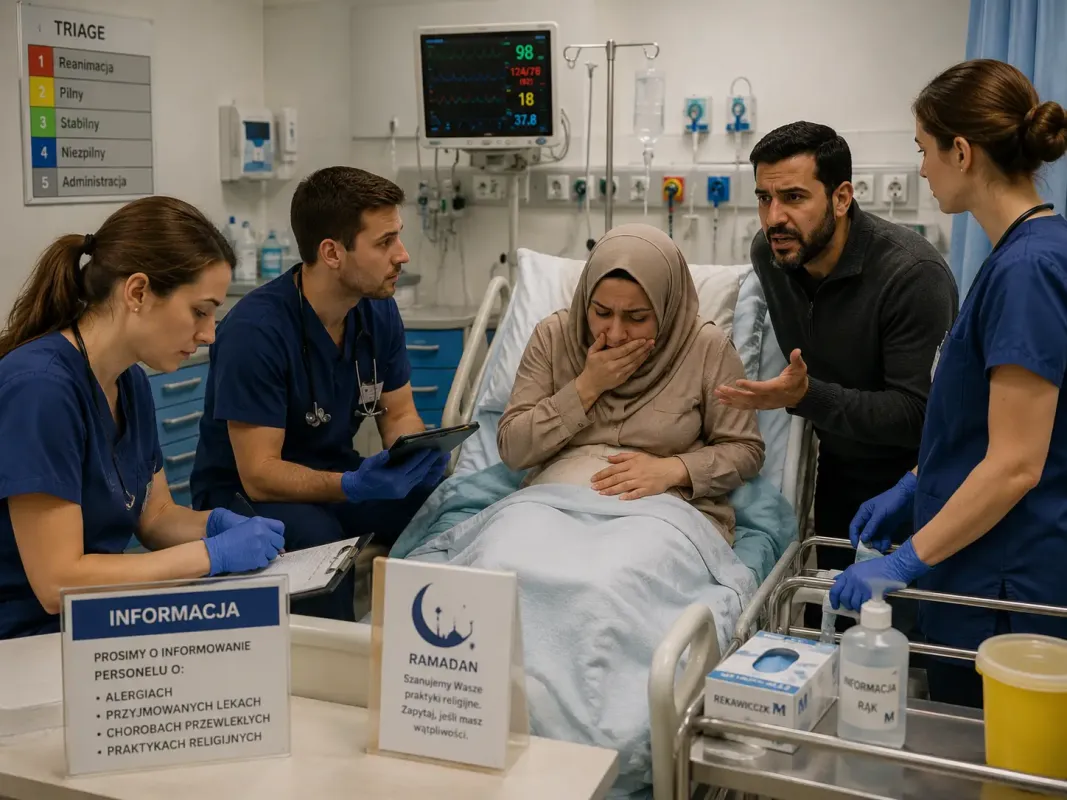
A medical simulation in which students care for Aisha Al-Karim, a 32-year-old Syrian Muslim patient presenting to the Emergency Department with acute abdominal pain, accompanied by her husband Omar. Working in role-assigned groups, students navigate the complexities of communicating with the patient and her husband while respecting Islamic principles (including Ramadan fasting and gender norms), managing emotions under pressure, and applying the EMPOWER model of culturally humbled practice.
Methodological Guide
Objectives
Develop awareness of how one's own cultural, emotional, and cognitive filters influence communication with a patient.
Improve the ability to recognise cultural differences in clinical practice.
Strengthen skills in building a therapeutic relationship with the patient and her family.
Participate in a medical simulation that enables practical application of the EMPOWER model in a clinical context.
Integrate professional competencies with cultural humility.
Improve the ability to recognise cultural differences in clinical practice.
Strengthen skills in building a therapeutic relationship with the patient and her family.
Participate in a medical simulation that enables practical application of the EMPOWER model in a clinical context.
Integrate professional competencies with cultural humility.
Expected Outcomes
After completing the exercise, students should be able to:
Recognise cultural elements affecting communication (Ramadan, gender roles, family involvement in decision-making).
Identify EMPOWER model elements applied in caring for the patient.
Formulate conclusions on how to transfer simulation experience into professional practice.
Balance respect for the patient's culture with legal and ethical standards.
Demonstrate awareness of the religious exemption from fasting during Ramadan when medical treatment is required.
Recognise cultural elements affecting communication (Ramadan, gender roles, family involvement in decision-making).
Identify EMPOWER model elements applied in caring for the patient.
Formulate conclusions on how to transfer simulation experience into professional practice.
Balance respect for the patient's culture with legal and ethical standards.
Demonstrate awareness of the religious exemption from fasting during Ramadan when medical treatment is required.
Exercise Procedure
Stage 1 – Prebriefing (20 min): Inform students about the topic, purpose, and structure. Ask opening questions based on objectives. Introduce the additional task: create an associative mind map for the phrase ‘Muslim woman as a patient’. Introduce students to the case description. Assign roles: Students 1–4 (active) and Observers 1–4.
Stage 2 – Orientation to Simulation Environment (5 min): Move to the simulation room. Familiarise students with the manikin, documentation, and physiological monitoring. Indicate designated places for observers. Conduct a brief technical rehearsal. Emphasise that consulting a physician is not possible during the scenario.
Stage 3 – Scenario (15–20 min): Setting: Emergency Department of a hospital in Szczecin. Aisha Al-Karim is waiting with her husband for medical interventions after initial triage. At the 5th minute, an order appears for IV administration of 1 g Metamizole in 250 ml 0.9% NaCl. Vital signs after measurement: temperature 37.8°C, HR 80/min, RR 20/min, BP 135/85 mmHg. The patient vomits during the scenario. The patient initially refuses IV therapy due to Ramadan. Husband insists on being consulted about all clinical decisions.
Stage 4 – Debriefing (30 min): Open with summary of key learning moments. Reflect on how communication space for the patient was established. Discuss the Islamic exemption from fasting during illness and its application to IV therapy. Ask students to assess their own growth on a scale of 1–10.
Stage 2 – Orientation to Simulation Environment (5 min): Move to the simulation room. Familiarise students with the manikin, documentation, and physiological monitoring. Indicate designated places for observers. Conduct a brief technical rehearsal. Emphasise that consulting a physician is not possible during the scenario.
Stage 3 – Scenario (15–20 min): Setting: Emergency Department of a hospital in Szczecin. Aisha Al-Karim is waiting with her husband for medical interventions after initial triage. At the 5th minute, an order appears for IV administration of 1 g Metamizole in 250 ml 0.9% NaCl. Vital signs after measurement: temperature 37.8°C, HR 80/min, RR 20/min, BP 135/85 mmHg. The patient vomits during the scenario. The patient initially refuses IV therapy due to Ramadan. Husband insists on being consulted about all clinical decisions.
Stage 4 – Debriefing (30 min): Open with summary of key learning moments. Reflect on how communication space for the patient was established. Discuss the Islamic exemption from fasting during illness and its application to IV therapy. Ask students to assess their own growth on a scale of 1–10.
Mode of Implementation
Group-based medical simulation (4 active students + up to 4 observer students). Stage 1: Prebriefing (20 min). Stage 2: Orientation to simulation environment (5 min). Stage 3: Scenario (15-20 min). Stage 4: Debriefing (30 min).
Role of the Teacher
Guide and moderator — leads prebriefing and debriefing, asks opening questions, paraphrases, uses motivational interviewing and empathic communication. Facilitator of reflection — challenges assumptions and biases; supports the transformation from 'I did it wrong' to 'What did I learn about myself and the patient today?' Group facilitator — ensures an atmosphere of safety, trust, and mutual respect. Simulation instructor — oversees scenario implementation and introduces students to the simulation environment. Observer — analyses the scenario, selects fragments for debriefing, reflects students' statements to help them identify stereotypes and biases.
Theoretical Basis
The exercise draws on the EMPOWER model (Effectiveness, Multicultural, Professionalism, Wellness, Educational Resources) applied in a clinical context. It employs transformative learning theory: a disorienting dilemma confronts students with the tension between standard clinical procedures and the patient's religious and cultural needs (Ramadan fasting, gender-related norms, husband-mediated decision-making). Critical reflection during the debriefing enables students to identify their own stereotypes, revise communication strategies, and integrate professional competence with cultural humility.
Practical Application
Students encounter the disorienting dilemma of a patient who initially refuses intravenous fluid therapy during Ramadan and defers all decisions to her husband. They must establish respectful communicative space for the patient herself, demonstrate knowledge of the religious exemption from fasting when medical treatment is required, organise a physical examination that respects Islamic principles of gender separation, and negotiate a plan of care that upholds both clinical safety and the patient's values.
Knowledge Transfer
The competencies developed in this scenario are universal: they transfer to all clinical contexts involving cultural, religious, or ideological differences. Students learn that cultural humility, negotiating solutions, and seeking compromise between medical requirements and patient values apply not only to Muslim patients but to all patients representing diverse value systems, lifestyles, or religious beliefs.
Reinforcement & Reflection
Reflective journal prompts:
What emotions did I experience when the patient spoke quietly and deferred to her husband?
What automatic thoughts arose about the patient and her family?
Did any associations or stereotypes related to Muslim women, Ramadan, or gender roles in the family arise for me?
How might my beliefs influence my communication and interpretation of the patient's behaviour?
Which good practices do I want to continue in my future professional work?
What emotions did I experience when the patient spoke quietly and deferred to her husband?
What automatic thoughts arose about the patient and her family?
Did any associations or stereotypes related to Muslim women, Ramadan, or gender roles in the family arise for me?
How might my beliefs influence my communication and interpretation of the patient's behaviour?
Which good practices do I want to continue in my future professional work?
Required Resources
Simulated patients or high-fidelity manikins portraying Aisha and Omar. Task sheets and clipboards with pens for observers. Whiteboard or flipchart with markers. Scripts for simulated patients or voice actors. IV infusion set with 1 g Metamizole in 250 ml 0.9% NaCl. Devices for measuring vital signs. Kidney dish or vomit bag. Medical order form, vital-sign chart, completed peripheral IV chart (or access to digital documentation).
Assessment / Evaluation
Self-assessment: Students rate their growth in competence in caring for a patient practising Islam on a scale from 1 to 10. Observer feedback: Each observer shares findings based on their assigned observation focus (communication and cultural sensitivity; safety and trust; therapeutic relationship; engagement and safety). Debriefing discussion: joint analysis of communication strategies, stereotypes identified, and plans for professional practice.
Practical Tips
Do not interrupt the simulation once it has begun — allow students to collaboratively search for solutions. Create a safe communication environment so that students can openly discuss their observations and emotions. Apply the principles of motivational interviewing and nonviolent communication. Use affirmations, paraphrasing, and clarification during both the prebriefing and the debriefing. Do not assign a physician consultation option — the scenario requires students to resolve the cultural and clinical tension themselves.
Discussion Topics
Which other groups of patients may encounter similar barriers (migrants from other cultures, older adults, persons with disabilities)?
How can religious practices (e.g., Ramadan, fasting, prayer, gender-related norms) influence the course of therapy?
How does cultural humility differ from cultural competence, and how can EMPOWER support not only students but entire clinical teams?
How can one maintain, in practice, a balance between respecting the patient's culture and upholding the patient's right to autonomous decision-making?
Which elements of the EMPOWER model were most prominently demonstrated during the simulation?
How can religious practices (e.g., Ramadan, fasting, prayer, gender-related norms) influence the course of therapy?
How does cultural humility differ from cultural competence, and how can EMPOWER support not only students but entire clinical teams?
How can one maintain, in practice, a balance between respecting the patient's culture and upholding the patient's right to autonomous decision-making?
Which elements of the EMPOWER model were most prominently demonstrated during the simulation?
Further Resources
Szkup Małgorzata, The EMPOWER Model – an Innovative Concept of Multicultural Education for Medical and Health Sciences Students, in: Modern Multicultural Education for Medical and Health Sciences Students, Chapter 1.
Additional Remarks
During the debriefing, the student receives reinforcing messages that encourage the maintenance of cultural openness. The student receives feedback regarding the effectiveness of their actions and experiences this effectiveness through participation in the scenario. The student may take an active role in the scenario again after the debriefing, implementing the agreed-upon corrections. This simulation is suitable for nursing, medical, and allied health students.