Exercise #55
Escape Room: The Code of Sacred Symbols
Authors: Dr Marzena Mikła (University of Murcia, Spain)
30–45 minutes
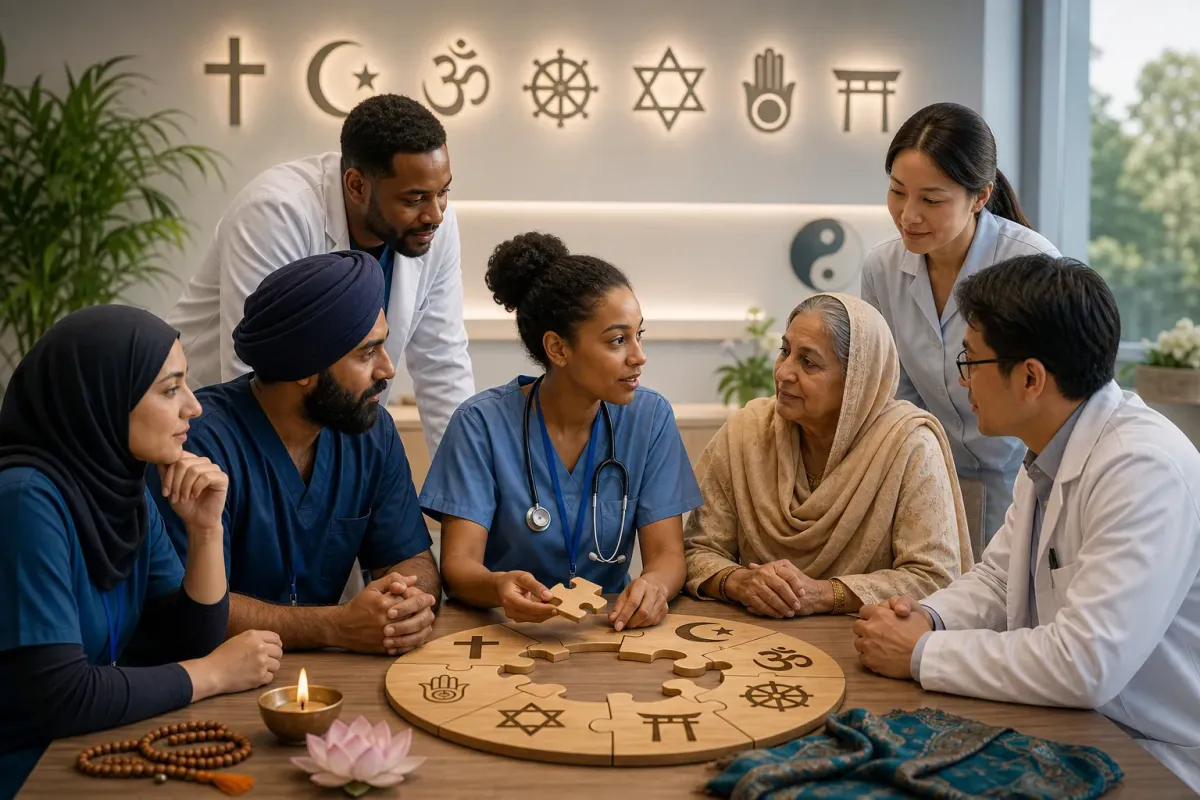
Description
An escape-room style exercise in which students work through 9 consecutive stations, each exploring a different world religion or culture. Students decipher clues, match symbols, solve puzzles and reflect on how religious and cultural diversity shapes healthcare practice.
Methodological Guide
Objectives
Identify the fundamental symbols, concepts and practices of the main religions and cultures covered.
Apply cultural and religious knowledge to solve puzzles and decipher clues.
Collaborate effectively, distributing tasks and communicating ideas to overcome challenges.
Reflect on the relationship between religious diversity and healthcare, highlighting its impact on clinical communication and decision-making.
Apply cultural and religious knowledge to solve puzzles and decipher clues.
Collaborate effectively, distributing tasks and communicating ideas to overcome challenges.
Reflect on the relationship between religious diversity and healthcare, highlighting its impact on clinical communication and decision-making.
Expected Outcomes
Identify clues and solve problems using cultural and religious knowledge.
Work effectively as a team, communicating and distributing tasks.
Apply prior knowledge of religious and cultural diversity.
Demonstrate cultural sensitivity and respect for diverse beliefs in a healthcare context.
Manage time and advance systematically through challenges.
Work effectively as a team, communicating and distributing tasks.
Apply prior knowledge of religious and cultural diversity.
Demonstrate cultural sensitivity and respect for diverse beliefs in a healthcare context.
Manage time and advance systematically through challenges.
Exercise Procedure
Introduction (5 min): Present the narrative — a traveller has lost sacred symbols representing the world's religious diversity and students must find them before midnight. Explain the rules: stations must be completed in order; if a task is not completed, you cannot advance. Active participation (30 min): Students work through all 9 stations consecutively, applying knowledge of each religion/culture to complete the station task. Final discussion (10 min): Discuss how religious symbols and practices influence healthcare. Reflect on teamwork, problem-solving, and cultural sensitivity. Summary (5 min): Key takeaways on religious diversity and its role in respectful, person-centred healthcare.
Mode of Implementation
Group-based escape-room activity. Students navigate 9 sequential digital stations, each representing a different religion or culture. Each station requires completing a task before advancing. Recommended team size: 2–5 students.
Role of the Teacher
Game Master and Guardian of the treasure: guides, controls the time and gives extra clues if the group gets stuck. Explains the rules of the game, the learning objectives, and how the stations should be navigated. Supervises during the activity, ensures students follow the rules and participate actively. Evaluates and motivates: observes participation, recognises achievements and promotes an atmosphere of respect and collaboration.
Theoretical Basis
Active learning: students participate directly in the construction of knowledge through meaningful, collaborative and problem-solving tasks. Constructivism: learning is deeper when students manipulate information, reflect on it and apply it in real or simulated situations. Escape rooms incorporate elements of challenge-based learning and experiential learning (D. Kolb), as participants must face dynamic situations, make decisions under pressure and analyse their own actions. From a skills perspective, escape rooms promote key skills such as teamwork, creativity, critical thinking, time management and decision-making, aligning with active methodologies recommended for higher education. They encourage the acquisition of cross-cutting skills, including cultural sensitivity, respect for diversity and effective communication, which are fundamental to quality healthcare.
Practical Application
Students use their knowledge of religions and cultures to resolve situations that mimic the real complexity of the healthcare setting. Through the stations, students learn to interpret religious symbols, beliefs and practices and to make respectful and culturally sensitive decisions, essential skills in caring for patients from diverse backgrounds. In addition, they train cross-cutting skills — such as communication, cooperation, and problem-solving under pressure — that are directly applicable to clinical and teamwork environments.
Knowledge Transfer
Students apply theoretical information about religions and cultures in a practical and dynamic context, similar to the situations of uncertainty and decision-making present in healthcare. By interpreting symbols, solving puzzles and connecting concepts in real time, students transfer what they have learned to a simulated environment that requires analysis, adaptation and communication.
Reinforcement & Reflection
Why is it important to know and respect people's religious symbols and practices when providing healthcare? What similarities and differences did you notice between the symbols of different religions, and how might these influence perceptions of illness, care, or wellbeing? How can understanding the values and beliefs represented by these symbols improve communication and empathy with patients from different cultures?
Required Resources
Digital device per student or team. Internet access. Optional: printed reference materials on world religions.
Assessment / Evaluation
Formative assessment through observation of team participation, quality of reasoning and ability to connect cultural knowledge to healthcare contexts. The team that completes all stations in the shortest time demonstrates the strongest combination of knowledge and collaboration. Optional: brief individual reflection post-activity.
Practical Tips
Prepare all stations in advance. Give clear instructions at the start. Be flexible and provide extra clues if needed. Ensure inclusion and active participation from all students. Connect theory to practice throughout. Record observations for post-activity feedback.
Discussion Topics
The importance of respect and understanding of religious and cultural diversity in the field of health. How do religious symbols and practices shape patients' expectations of care? What did you discover about religions you were less familiar with? How can healthcare professionals demonstrate cultural competence without stereotyping?
Further Resources
The book Multicultural Education for Medical and Health Sciences Students. Chapter: Religious, Spiritual and Cultural Practices Related to Health. Author Marzena Mikła. MultiCultiMed Project, online version at www.multicultimed.pl
Additional Remarks
This escape room is suitable for nursing, medical, and allied health students. All 9 stations are mandatory — students must complete each one before advancing. The exercise can be adapted for classroom delivery using physical materials as described in the methodological guide.