Exercise #21
Care for a Female Patient from the Romani Culture
Authors: Dr n. zdr. Aleksandra Brodowska
70-75 minutes
Description
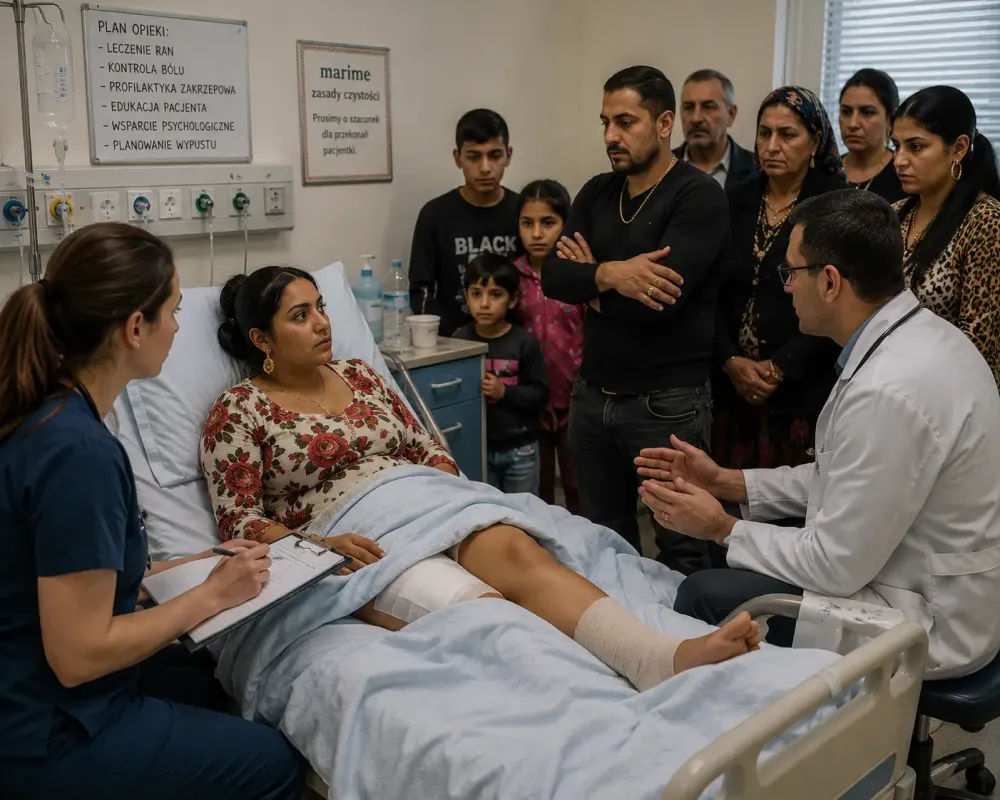
A medical simulation in which students care for Esmeralda Mirga, a 30-year-old Romani patient hospitalised following a traffic accident.
Working in role-assigned groups, students navigate the complexities of communicating with the patient and her large multigenerational family while respecting the Romani concept of marime (purity and impurity), managing emotions under pressure, and applying the EMPOWER model of culturally humbled practice.
Methodological Guide
Objectives
Raise students' awareness of how their own cultural, emotional, and cognitive filters influence communication with a patient of Romani origin.
Develop competencies for communicating with a large family group in situations of cultural tension.
Strengthen skills in managing emotions and the dynamics of a multigenerational family group.
Shape a respectful attitude toward the Romani concept of marime (purity and impurity).
Raise awareness of how stereotypes and prejudices affect the therapeutic relationship.
Implement the EMPOWER model in clinical practice related to the Romani community.
Integrate professional competencies with cultural humility.
Develop competencies for communicating with a large family group in situations of cultural tension.
Strengthen skills in managing emotions and the dynamics of a multigenerational family group.
Shape a respectful attitude toward the Romani concept of marime (purity and impurity).
Raise awareness of how stereotypes and prejudices affect the therapeutic relationship.
Implement the EMPOWER model in clinical practice related to the Romani community.
Integrate professional competencies with cultural humility.
Expected Outcomes
After completing the exercise, students should be able to:
Identify cultural elements that influence communication (concepts of impurity, gender roles, and the presence of a large family group).
Indicate the EMPOWER model components that were applied in caring for the patient.
Formulate conclusions on how to transfer the simulation experience into professional practice.
Analyse their own emotional reactions and potential stereotypes toward Romani patients.
Develop a deeper understanding of how cultural context influences the interpretation of information and communication in professional settings.
Identify cultural elements that influence communication (concepts of impurity, gender roles, and the presence of a large family group).
Indicate the EMPOWER model components that were applied in caring for the patient.
Formulate conclusions on how to transfer the simulation experience into professional practice.
Analyse their own emotional reactions and potential stereotypes toward Romani patients.
Develop a deeper understanding of how cultural context influences the interpretation of information and communication in professional settings.
Exercise Procedure
Stage 1 – Prebriefing (20 min): Inform students about the topic, purpose, and structure. Ask opening questions based on objectives. Use motivational interviewing and empathic communication. Introduce students to the case description. Assign roles: Students 1–4 (active) and Observers 1–4 (EMPOWER roles).
Stage 2 – Orientation to Simulation Environment (5 min): Move to the simulation room. Familiarise students with the manikin, documentation, and physiological monitoring. Indicate designated places for observers. Conduct a brief technical rehearsal. Emphasise that consulting a physician is not possible during the scenario.
Stage 3 – Scenario (15–20 min): Setting: surgical ward, second day of hospitalisation. The family accompanies Esmeralda and wishes to be present during measurements. The patient and mother protest strongly when students ask the patient to shower. The family participates actively in all decisions. Instructor observes via one-way mirror and camera.
Stage 4 – Debriefing (30 min): Open with summary of key learning moments. Reflect on how the large family presence was a source of safety. Discuss the concept of marime and its impact on hygiene decisions. Ask students to assess their own growth on a scale of 1–10.
Stage 2 – Orientation to Simulation Environment (5 min): Move to the simulation room. Familiarise students with the manikin, documentation, and physiological monitoring. Indicate designated places for observers. Conduct a brief technical rehearsal. Emphasise that consulting a physician is not possible during the scenario.
Stage 3 – Scenario (15–20 min): Setting: surgical ward, second day of hospitalisation. The family accompanies Esmeralda and wishes to be present during measurements. The patient and mother protest strongly when students ask the patient to shower. The family participates actively in all decisions. Instructor observes via one-way mirror and camera.
Stage 4 – Debriefing (30 min): Open with summary of key learning moments. Reflect on how the large family presence was a source of safety. Discuss the concept of marime and its impact on hygiene decisions. Ask students to assess their own growth on a scale of 1–10.
Mode of Implementation
Group-based medical simulation (4 active students + up to 4 observer students). Stage 1: Prebriefing (20 min). Stage 2: Orientation to simulation environment (5 min). Stage 3: Scenario (15-20 min). Stage 4: Debriefing (30 min).
Role of the Teacher
Guide and moderator — leads the prebriefing and debriefing, asks opening questions, paraphrases, and applies motivational interviewing and empathic communication. Reflects students' statements and behaviours, supporting them in identifying their own stereotypes and biases. Facilitator of reflection — asks questions that challenge students' assumptions and prejudices. Supports the transformation from 'I did something wrong' to 'What have I learned today about myself and the patient?' Group facilitator — ensures an atmosphere of safety, trust, and mutual respect. Medical simulation instructor — ensures that the simulation follows the session objectives and introduces students to the simulation environment. Observer — analyses the scenario, selecting key fragments for the debriefing.
Theoretical Basis
The exercise is grounded in the EMPOWER model (Effectiveness, Multicultural, Professionalism, Wellness, Educational Resources) applied to clinical practice with the Romani community. It draws on transformative learning theory: a disorienting dilemma confronts students with the tension between the ward's routines and the patient's need for family presence and cultural safety. Critical reflection during the debriefing enables students to identify their own stereotypes, analyse communication strategies, and develop plans integrating professional competence with cultural humility.
Practical Application
Students experience a disorienting dilemma when the large presence of the patient's family appears to interfere with ward workflow, yet deeper interaction reveals it is a crucial source of support and safety for the patient. They are confronted with stereotypes about the Romani community as 'demanding' when family emotional reactions turn out to be expressions of care and a culturally grounded obligation. They encounter the conflict between individual medical autonomy and the patient's expectation of collective family decision-making.
Knowledge Transfer
The experience gained during the simulation enables students to develop awareness of their own emotional reactions and stereotypes, and fosters the ability to critically analyse cultural determinants within the healthcare process. Competencies acquired in this scenario are universal — they transfer to other clinical contexts involving cultural, religious, or ideological differences. Participants learn that the principles of cultural humility, negotiating solutions, and seeking compromise between medical requirements and patient values apply not only to ethnic minorities but also to patients representing diverse value systems, lifestyles, or religious beliefs.
Reinforcement & Reflection
Reflection journal prompts:
How did I perceive the presence of the patient's large family — as support or obstacle?
How can I incorporate the principles of purity and impurity (marime) into practice without compromising clinical safety?
How did I react to the patient's expectation of collective family decision-making?
Which communication strategies helped me build the patient's and family's trust?
During the simulation, did I become aware of any stereotypes I might hold about Roma people?
How did I perceive the presence of the patient's large family — as support or obstacle?
How can I incorporate the principles of purity and impurity (marime) into practice without compromising clinical safety?
How did I react to the patient's expectation of collective family decision-making?
Which communication strategies helped me build the patient's and family's trust?
During the simulation, did I become aware of any stereotypes I might hold about Roma people?
Required Resources
Simulated patients or high-fidelity manikins portraying Esmeralda and family members. Task sheets and clipboards with notepads for observers. Whiteboard or flipchart with markers. Vital sign chart or electronic documentation system. Measurement instruments (blood pressure cuff, thermometer). Hygiene supplies: cleaning agents, towels, two bowls, tissues. Herbs and food packages (brought by the simulated family). Character costumes for Esmeralda (long skirt, headscarf, bracelets) and her mother.
Assessment / Evaluation
Self-assessment: Students rate their growth in competence in caring for a patient from the Romani community on a scale from 1 to 10. Observer feedback: Each observer shares findings based on their EMPOWER role (Effectiveness, Multicultural, Professionalism, Wellness/Educational Resources). Debriefing discussion: joint analysis of communication strategies, stereotypes identified, and plans for professional practice.
Practical Tips
Do not interrupt the simulation once it has begun — allow students to collaboratively search for solutions. Create a safe communication environment so that students can openly discuss their observations and emotions. Apply the principles of motivational interviewing and nonviolent communication. Use affirmations, paraphrasing, and clarification during both the prebriefing and the debriefing. Do not assign a physician consultation option — the scenario requires students to resolve the cultural and clinical tension themselves.
Discussion Topics
The role of the family in patient care – how to find a balance between the organisational requirements of the ward and the patient's need to have relatives present?
The limits of cultural compromise – to what extent can healthcare staff adapt to the patient's customs while maintaining clinical safety?
The concept of marime – how can hygiene care be designed so that it aligns with the patient's beliefs regarding purity and impurity?
Patient autonomy versus family decision-making – how should one proceed when the patient expects decisions to be made collectively?
Stereotypes and communication – how can stereotypes about Roma people be identified and neutralised in everyday clinical work?
Cultural humility – how does cultural humility differ from mere 'tolerance,' and how can it influence the quality of patient care?
Professionalism in conflict situations – how to maintain a professional attitude when emotions of the patient and family are strong.
The limits of cultural compromise – to what extent can healthcare staff adapt to the patient's customs while maintaining clinical safety?
The concept of marime – how can hygiene care be designed so that it aligns with the patient's beliefs regarding purity and impurity?
Patient autonomy versus family decision-making – how should one proceed when the patient expects decisions to be made collectively?
Stereotypes and communication – how can stereotypes about Roma people be identified and neutralised in everyday clinical work?
Cultural humility – how does cultural humility differ from mere 'tolerance,' and how can it influence the quality of patient care?
Professionalism in conflict situations – how to maintain a professional attitude when emotions of the patient and family are strong.
Further Resources
Kinga Lisowska, Majka Łojko (2024). Cultural Identity of Romani Women in Multigenerational Family Spaces. Kultura i Edukacja, no. 3 (145), pp. 11–26.
Karol Parno Gierliński (2023). Women in the Romani Community – Language, Stereotypes, Rituals. Związek Romów Polskich (Polish Roma Association).
Agnieszka J. Kowarska (2022). Women's Leadership and the Everyday Life of Romani Families. Kultura Enter.
Karol Parno Gierliński (2023). Women in the Romani Community – Language, Stereotypes, Rituals. Związek Romów Polskich (Polish Roma Association).
Agnieszka J. Kowarska (2022). Women's Leadership and the Everyday Life of Romani Families. Kultura Enter.
Additional Remarks
During the debriefing, the student receives reinforcing feedback that encourages the maintenance of cultural openness. The student experiences the effectiveness of the EMPOWER model in action. This simulation is suitable for nursing, medical, and allied health students. Character descriptions must be prepared carefully to ensure cultural authenticity without stereotyping.