Exercise #23
Care for a Patient from the Hasidic Community – Medical Simulation
Authors: Dr n. zdr. Aleksandra Brodowska, prof. UMMSC
Description
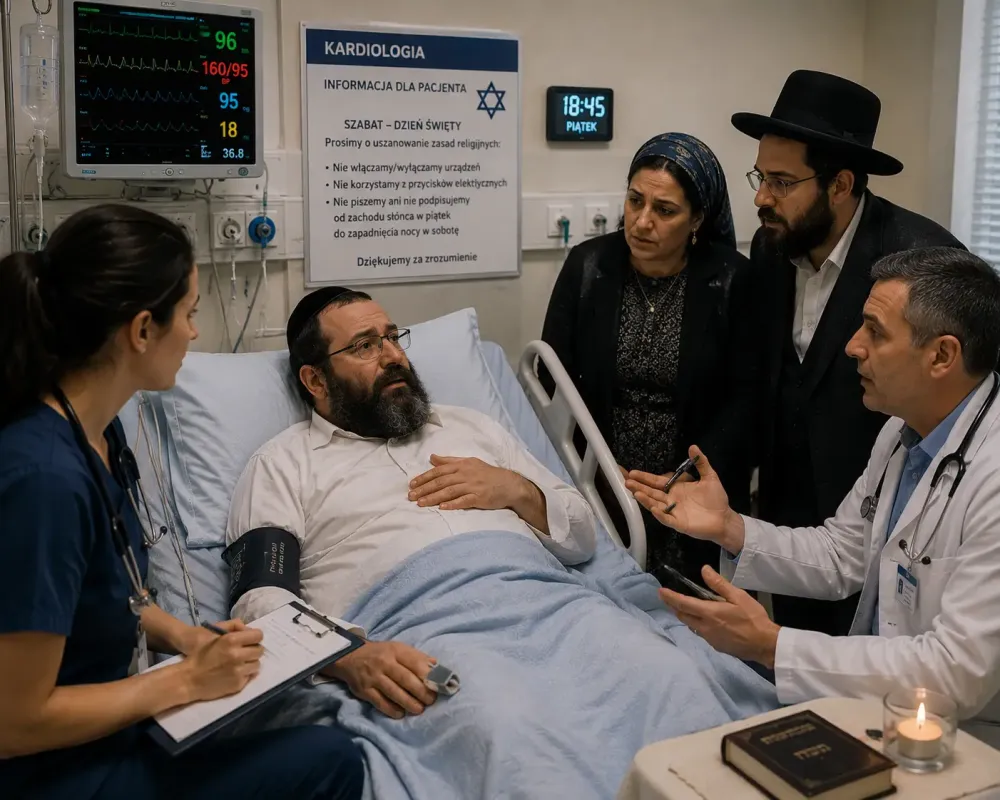
A four-stage medical simulation exercise in which students explore cultural and religious dimensions of caring for a Hasidic patient. Before the simulation, students map their own beliefs and assumptions. During the simulation, they review the clinical case, perform assigned roles in the scenario, and conclude with structured post-simulation reflection to integrate cultural humility with clinical practice.
Methodological Guide
Objectives
Learn practical strategies for minimising conflict between clinical requirements and religious rules.
Develop self-reflection and critical thinking in ethical and cultural contexts.
Integrate professional competence with cultural humility.
Practice communication and teamwork in a culturally sensitive clinical scenario.
Develop self-reflection and critical thinking in ethical and cultural contexts.
Integrate professional competence with cultural humility.
Practice communication and teamwork in a culturally sensitive clinical scenario.
Expected Outcomes
Students will be able to identify key Hasidic religious practices relevant to clinical care (Shabbat, kosher, gender separation). Students will demonstrate cultural humility by acknowledging and questioning their own assumptions. Students will apply the EMPOWER model or equivalent framework in a simulation debriefing.
Exercise Procedure
Stage 1 (pre-class): Distribute My Belief Map Part 1 worksheet. Students complete individually before class.
Stage 2: Present the clinical case of Moshe Cohen. Allow students to ask clarifying questions.
Stage 3: Conduct the simulation. Four students take active roles; four students act as observers using structured observation sheets.
Stage 4: Individual post-simulation reflection using My Belief Map Part 2. Optional: small-group share-out.
Stage 2: Present the clinical case of Moshe Cohen. Allow students to ask clarifying questions.
Stage 3: Conduct the simulation. Four students take active roles; four students act as observers using structured observation sheets.
Stage 4: Individual post-simulation reflection using My Belief Map Part 2. Optional: small-group share-out.
Mode of Implementation
Blended: individual pre-class task (Stage 1) completed asynchronously; simulation (Stages 2–3) in groups of 4 students plus 4 observers; individual post-simulation reflection (Stage 4).
Role of the Teacher
Facilitate the pre-class task introduction and debrief. Assign simulation roles. During the scenario, guide role-players without over-directing. Lead the post-simulation debriefing using the reflection prompts. Ensure a safe, non-judgmental learning environment throughout.
Theoretical Basis
The exercise is grounded in cultural humility, which calls for ongoing self-reflection and awareness of power imbalances in clinical relationships. It draws on the EMPOWER model (referenced in the pre-class belief-map worksheet) as a structured framework for culturally safe communication with religious patients.
Practical Application
Students complete a belief-mapping worksheet before class to surface assumptions, then engage with a realistic case of a Hasidic patient presenting with acute chest pain. Assigned clinical and observer roles during the simulation mirror actual ward team dynamics and require applying cultural and religious knowledge in real time.
Knowledge Transfer
After the simulation, students revisit their pre-class belief map to identify which assumptions changed. Reflection prompts target three domains: Shabbat restrictions, kosher rules, and caregiver gender — connecting simulation experience to future clinical encounters with observant Jewish patients.
Reinforcement & Reflection
Stage 4 asks students to compare their pre- and post-simulation beliefs and to rate their cultural competence on a scale of 1–10. Observer roles during the simulation (Stage 3) provide structured feedback on cultural sensitivity, procedural respect, and conflict management.
Required Resources
Simulation room or skills lab with basic cardiac monitoring equipment. Role cards for 4 active students and 4 observers. My Belief Map worksheets (Stages 1 and 4). Knowledge of Hasidic religious practices (provided in the case notes).
Assessment / Evaluation
Formative: observer feedback during simulation using structured observation criteria. Reflective: individual written responses in Stages 1 and 4 (My Belief Map). Self-assessment: competence rating (1–10) completed in Stage 4.
Practical Tips
Encourage students to be honest in the belief-mapping task — emphasise that there are no right answers, only personal starting points. The aim is self-awareness, not evaluation.
Discussion Topics
How do Shabbat restrictions affect clinical decision-making?
How can a healthcare team balance religious obligations with urgent medical needs?
What communication strategies support patients who observe strict gender separation?
How can cultural assumptions affect diagnosis and treatment adherence?
How can a healthcare team balance religious obligations with urgent medical needs?
What communication strategies support patients who observe strict gender separation?
How can cultural assumptions affect diagnosis and treatment adherence?
Additional Remarks
This simulation uses a Hasidic patient scenario. Ensure students understand that the Hasidic community is not monolithic; individual variation exists. The EMPOWER model (Explain, Manage, Provide, Options, Warn, Educate, Return) can be introduced as a structured framework in the pre-simulation briefing.