Exercise #46
Multicultural Reception
Authors: E. Burbela, O. Fedortsiv, V. Dzyvak
25 minutes
Description
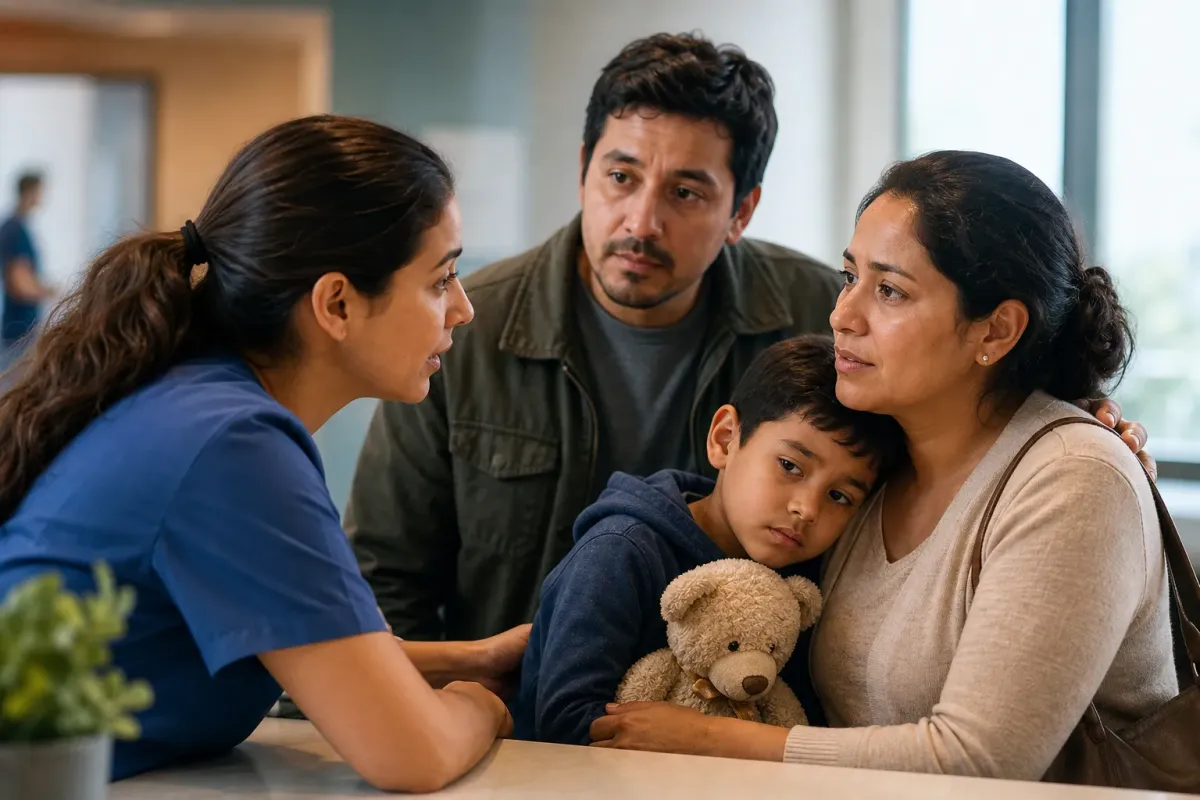
An interactive, case-based exercise in which participants explore multicultural clinical reception and develop culturally responsive, empathetic communication skills. Through a branching decision scenario set in a primary care triage context, students experience first-hand how the first thirty seconds of reception can determine whether an undocumented family with a sick child receives timely care.
Methodological Guide
Objectives
1. Recognise and consider the impact of cultural beliefs, values, traditions, and language on a patient's understanding of illness, treatment decisions, and adherence to recommendations.
2. Identify potential cultural barriers in communication and interaction with patients from diverse ethnic and cultural backgrounds.
3. Apply active listening and empathy techniques to understand patients' cultural perspectives.
4. Use verbal and non-verbal strategies that build trust and understanding with patients from diverse cultural backgrounds.
5. Adapt communication style to the patient's cultural context, including using interpreters when needed.
6. Express respect for cultural differences and avoid stereotyping in clinical decision-making.
7. Identify and address personal cultural biases to provide unbiased, quality care.
2. Identify potential cultural barriers in communication and interaction with patients from diverse ethnic and cultural backgrounds.
3. Apply active listening and empathy techniques to understand patients' cultural perspectives.
4. Use verbal and non-verbal strategies that build trust and understanding with patients from diverse cultural backgrounds.
5. Adapt communication style to the patient's cultural context, including using interpreters when needed.
6. Express respect for cultural differences and avoid stereotyping in clinical decision-making.
7. Identify and address personal cultural biases to provide unbiased, quality care.
Expected Outcomes
Students will gain a better understanding of intercultural competence, the role of language, and ethical frameworks in interacting with patients and families. They will acquire practical skills in active listening, adapting communication to cultural contexts, and effectively engaging interpreters. They will develop the ability to reflectively assess their own biases and apply ethical practices in real-world intercultural situations.
Exercise Procedure
Stage 1 — Reception Decision Scenario (15 min): Navigate a branching decision tree centred on an undocumented family arriving at triage with a sick 6-year-old before the clinic fills. Your choices determine the clinical and human outcome. Stage 2 — Written Reflection (10 min): Write one concrete reception behaviour you will apply next time an undocumented family arrives outside appointment hours.
Mode of Implementation
Group activity
Role of the Teacher
The teacher briefly introduces the topic and explains the objectives (5 min), divides participants into groups and assigns scenario numbers, monitors group preparation, and conducts a facilitated debrief discussion after each group's presentation. The teacher evaluates participation, depth of reflection, and engagement in discussion.
Theoretical Basis
The exercise draws on several theoretical frameworks: (1) The role of family and social context — in many cultures, decisions may be made within the family or with the involvement of spiritual leaders, which must be considered during consent and treatment planning. (2) Religious and cultural beliefs — these may limit or modify the choice of treatment methods (e.g. refusal of certain procedures, use of alternative practices). (3) Language and communication adaptability — use of simple language, checking for understanding, use of visual materials and interpreters as needed. (4) Ethical principles in an intercultural context — patient autonomy, non-discrimination, confidentiality, respect for cultural differences, and commitment to impartial care.
Practical Application
Students will learn to recognise cultural differences in patients and families that influence treatment decisions and adapt their explanations accordingly. They will practise active listening, emotional reflection, and identifying unspoken needs to build trust and reduce cultural barriers. Students will also learn to appropriately engage interpreters and cultural mediators, define the roles and boundaries of their involvement, and consciously identify their own biases for reflective, culturally sensitive practice.
Knowledge Transfer
The transfer of knowledge involves clearly articulating key concepts of intercultural competence, active listening, and ethical frameworks. Transformation means developing in students the ability to critically reflect on their own biases, integrate culturally sensitive practices into clinical work, and apply acquired skills in real-life intercultural interactions with patients.
Reinforcement & Reflection
Reflection questions for the debrief:
• What emotions did you feel during the exercise?
• What was most difficult in your assigned role?
• How did your understanding of the situation change after group interaction?
• Did you discover previously unrecognised assumptions?
• How did context (talking to a minor vs adult, family member vs patient) change your communication approach?
• What signals from mediators influenced the course of the conversation?
• How did you sense the emotional state of the patient and family?
• Were there moments when clinical priorities overshadowed patient autonomy?
• What emotions did you feel during the exercise?
• What was most difficult in your assigned role?
• How did your understanding of the situation change after group interaction?
• Did you discover previously unrecognised assumptions?
• How did context (talking to a minor vs adult, family member vs patient) change your communication approach?
• What signals from mediators influenced the course of the conversation?
• How did you sense the emotional state of the patient and family?
• Were there moments when clinical priorities overshadowed patient autonomy?
Required Resources
Ready-made scenarios (Appendix 1)
Assessment / Evaluation
Teacher's choice among: self-assessment (reflective journal questions, short written feedback), peer assessment (group discussion, peer feedback), or teacher observation (quality of participation, depth of reflection, engagement in discussion).
Practical Tips
Provide a safe space: clearly outline rules of respect, active listening, and non-violent communication. Leave space for diverse voices: ask those who are usually silent if they are willing to share. Take notes and summarise: help participants see patterns and conclusions. Insert action steps: at the end of each block, ask what specific actions participants are willing to take.
Discussion Topics
1. The concept of 'norm' in the modern medical world.
2. The ethical limits of cultural adaptation.
3. The impact of globalisation on daily clinical practice.
Stage 2: Written Reflection
You have just navigated a reception scenario where administrative protocol and immediate clinical need pulled in opposite directions. Now write one concrete commitment. There are no correct answers — only honest ones.
- What's one reception behaviour (a concrete phrase, gesture, or sequence) you will use next time an undocumented family arrives outside appointment hours?
2. The ethical limits of cultural adaptation.
3. The impact of globalisation on daily clinical practice.
Stage 2: Written Reflection
You have just navigated a reception scenario where administrative protocol and immediate clinical need pulled in opposite directions. Now write one concrete commitment. There are no correct answers — only honest ones.
- What's one reception behaviour (a concrete phrase, gesture, or sequence) you will use next time an undocumented family arrives outside appointment hours?
Further Resources
Kempny, C. et al. (2025). Competence development among healthcare professionals through an online diversity training — a scoping review. BMC Medical Education. 25. doi:10.1186/s12909-025-07745-z.
Dr & Flynn, S. (2025). Child Protection and Disability: An Anti-Oppressive Reading.
Varga, S. & Latham, A. (2025). Medicine, Pseudomedicine, and "Folk Medicine". doi:10.1093/oxfordhb/9780197625835.013.0010.
Dr & Flynn, S. (2025). Child Protection and Disability: An Anti-Oppressive Reading.
Varga, S. & Latham, A. (2025). Medicine, Pseudomedicine, and "Folk Medicine". doi:10.1093/oxfordhb/9780197625835.013.0010.