Table of Contents
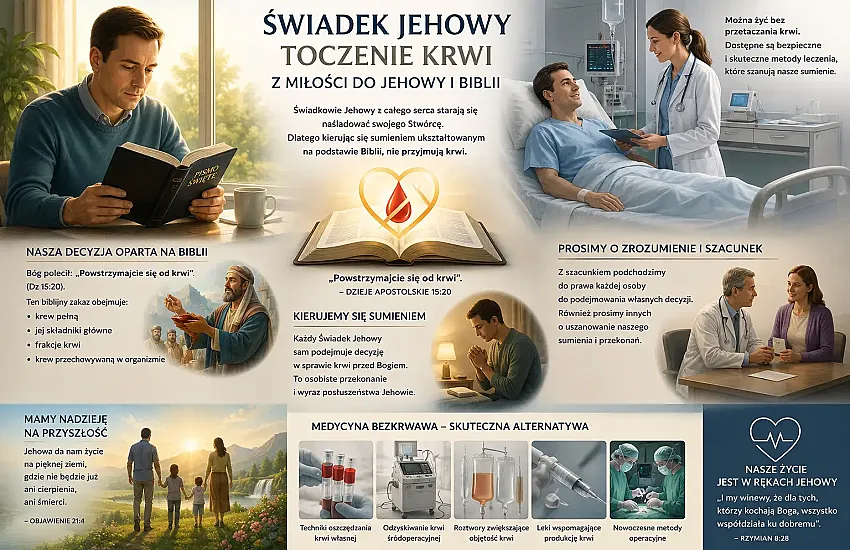
Jehovah’s Witnesses are known for refusing blood transfusions, which stems from their interpretation of biblical commands regarding blood. At the same time, this does not mean refusing medical treatment—on the contrary, over the past decades many modern and effective medical methods have been developed that make it possible to protect health and save lives without the use of blood. Modern medicine increasingly refers to this approach as “Patient Blood Management” (PBM).
Modern Approach – Bloodless Medicine
Modern medicine offers a wide range of alternatives to transfusion that are used not only for Jehovah’s Witnesses, but also for other patients, due to the lower risk of complications.
The most important methods include:
the use of drugs that stimulate the production of red blood cells (e.g. erythropoietin),
iron preparations and vitamins that support blood formation,
modern surgical techniques that reduce blood loss (e.g. minimally invasive surgery),
devices for recovering the patient’s own blood during surgery (so-called cell salvage—in some cases accepted on an individual basis),
the use of agents that reduce or stop bleeding.
This approach not only respects the patient’s religious beliefs, but often also improves the safety of treatment.
Standard Pillars of Bloodless Treatment (PBM)
Modern treatment strategies that avoid the use of blood are based on three main pillars:
Optimization of Blood Production
The goal is to prepare the patient’s body before a procedure or during illness.
This includes:
treating anemia,
supplementation with iron, vitamin
B12
B12, and folic acid,
the use of drugs that stimulate the bone marrow to produce blood cells.
Thanks to this, the body is better prepared for possible blood loss.
Minimization of Blood Loss
This is a key element of modern surgical medicine.
Methods include:
precise surgical techniques,
laparoscopic and robotic operations,
medications that reduce bleeding (e.g. tranexamic acid),
blood pressure control during surgery,
limiting the number of blood draws for testing.
The aim is to reduce blood loss as much as possible at every stage of treatment.
Optimal Use of the Patient’s Own Blood
Instead of replacing blood, doctors focus on making the best possible use of the blood the patient already has.
This includes:
blood recovery techniques during surgery (if accepted),
proper hydration and maintenance of circulating blood volume,
the use of preparations that increase the blood’s oxygen-carrying capacity,
an individualized approach to medical decisions.
Boundaries and Individual Decisions
Although Jehovah’s Witnesses reject transfusions of whole blood and its main components, some procedures or preparations may be accepted individually. Each patient makes decisions according to their conscience, often after consulting with a physician.
In practice, this means dialogue between medical staff and the patient, as well as seeking solutions that are consistent both with medical knowledge and with religious beliefs.
Significance for Modern Medicine
The development of bloodless methods is no longer a niche area. More and more hospitals around the world are implementing PBM strategies as a standard of care because they:
reduce the risk of complications,
shorten hospital stays,
improve treatment outcomes.
What initially developed largely with Jehovah’s Witnesses in mind is now becoming an important direction in modern medicine.
Summary
Jehovah’s Witnesses’ approach to blood transfusions has contributed to the development of advanced treatment methods that avoid the use of blood. Modern medicine shows that, thanks to proper patient preparation, modern surgical techniques, and conscious blood management, effective treatment is possible even in difficult cases—without the need for transfusion.